

IN THE NEWS
How Ambi is bringing physical AI to industrial package stacking
With accelerating interest in physical AI, impressive robot manipulation videos on dexterous tasks are commonplace. Yet there are few AI-powered robotic companies operating in production today. This is because robot manipulation has struggled to achieve the speed and reliability required for industrial applications.
Ambi Robotics operates under the thesis that the industry needs agentic robotics architecture for physical AI to achieve a level of mastery that unlocks commercial applications. This includes a harness for reasoning, safety, monitoring, performance tuning, and fallback mechanisms. This can transform prototype policies into dependable systems that operate 24/7 in industrial environments.
Ambi Robotics sees physical AI opportunity

A key area for agentic and physical AI development is reasoning about space and physics. Existing AI agents can plan digital actions in plain language. However, physical AI requires choosing not only which dexterous policy to invoke, but also where in space to invoke it. And it must do this in a way that respects geometry, contact, and stability.
This is especially relevant for industrial package-stacking tasks. These represent a huge amount of manual labor across manufacturing, logistics, and transportation.
Ambi Robotics estimates that more than $400 billion is spent annually worldwide on physical work for just stacking alone. This can range from truck loading and pallet building to order fulfillment. These jobs are monotonous and back-breaking, leading to high turnover.
Despite the huge opportunity, industrial package stacking has remained a stubborn challenge for physical AI. This is because it is a 3D version of the popular Tetris game, which is known to be computationally complex. Package stacking is also challenging because of item variation, contact physics, and long time horizons.
Most manual operations have people densely stacking items on the fly. In these situations, objects can range from an envelope to a 50 lb. box.
Neither teleoperation nor classical solvers address this on-the-fly regime. Humans struggle at bin packing under uncertainty, which is why they often have to rework pallets. Most analytic algorithms attempt to solve NP-hard variants of 3D knapsack that assume full control over the item sequence. For both of these reasons, recent research has explored using reinforcement learning (RL) to progress toward better online 3D bin-packing algorithms.
Introducing CARGO: Sim2real reinforcement learning for production-grade stacking

This week, Ambi Robotics announced CARGO — Contact-Aware Reinforcement-learned Generalized Object-stacking — a physical AI reasoning model for item stacking. The company trains CARGO with Sim2Real reinforcement learning to stack in simulation.
Ambi then applies the system to real packages, deciding high-level actions for which item to stack next and where to place it. Existing dexterous manipulation AI skills in AmbiOS execute low-level behaviors. Ambi has already deployed CARGO to robots in customer operations, building stacks at state-of-the-art densities.
CARGO chooses where to stack packages to optimize the density of the final stack. It does this by reasoning over the current stack, the items available to pick, the items about to arrive on the conveyor, and the collision-free actions the robot can execute.
Density-maximizing behaviors emerge from reinforcement learning in a proprietary simulation. This simulation models contact physics, inertial properties, and stack stability under uncertainty. It is also highly optimized for evaluation speed, producing realistic container states in microseconds.
Training runs perform over 40 million stack actions across randomized items, distributed across hundreds of NVIDIA GPU nodes with Ray.
CARGO generalizes well to new item distributions, Ambi said. It achieves high performance with little-to-no adaptation. In simulated rollouts on package data from customer production, CARGO exceeds 75% density, over 15% higher than the best baseline analytic algorithm the Ambi benchmarked against.
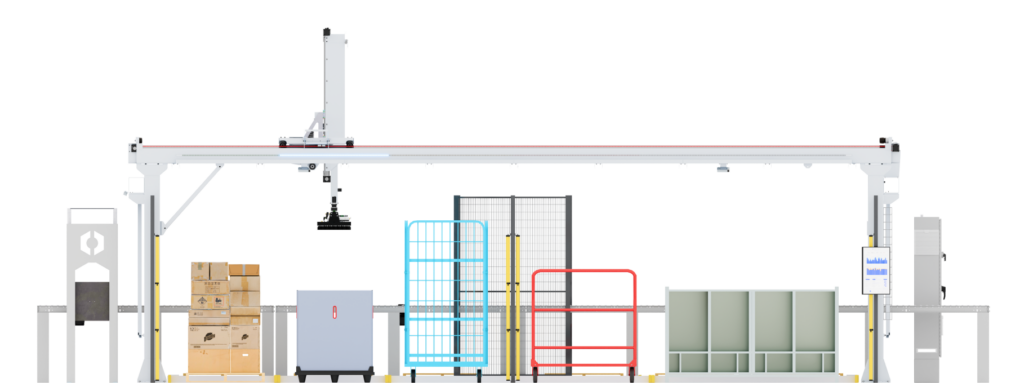
The company also deployed CARGO onto AmbiStack, its robot for mixed on-the-fly box stacking onto pallets and into walled containers. In live production evaluation, CARGO has achieved over 72.5% density at more than 340 sorts per hour. Both numbers climbed as production data flows back into training. Direct comparisons are sparse within the literature and can vary across actual warehouse conditions. However, these results suggest that CARGO can achieve similar density to humans at 1.5-2x throughput.
The following sections provide more detail on CARGO’s training and performance. This includes how Ambi structured stacking as a planning problem, details on the simulator, how policies transfer across item distributions, and what production data tells Ambi about where Sim2Real task planning goes next.

Ambi uses experimental setup for training
CARGO’s goal is to generalize across unseen box distributions while being able to quickly adapt to new box sequences and distributions.
To achieve this, Ambi trains a base model on a large, diverse set of boxes and box sequences. First, the company shows how scaling pre-training for this base model can lead to strong out-of-the-box performance. This is true across box distributions and sequences unseen in training.
Second, it shows that in cases where test box distributions differ significantly from the training box distribution, post-training the base model can quickly recover the performance of training from scratch on the new box distribution directly.
Scaling density helps with box constraints, time
A key challenge in scaling training for CARGO has been to balance realistic box constraints such as stability and placement feasibility with simulation time. Ambi wants to allow the policy to quickly transition from placement to placement. This allows it to explore a wide variety of potential box distributions, sequences, and intermediate packing states.
At the same time, the company wants to limit the policy to choosing action sequences that it can actually execute on the physical hardware. Within this vein, it has developed a simulator that can validate a set of potential box placements respecting hardware feasibility and stability constraints. It can also return a realistic container state within microseconds.
This breakthrough has unlocked consistent performance gains in CARGO’s ability to densely load containers, Ambi said. It has scaled its simulation data from nearly 4 million box placements during training to almost 40 million. This increased density bt an average of 7% across two scenarios.
In the figure below, Scenario 1 and Scenario 2 represent two different packing container sizes with similar box distributions, showing that scaling holds across varied application specifics in training. In addition, these results suggest that training on even more simulated placements and containers could continue to improve density. Computation time and budget were the only limitations on experiments in this report, and Ambi aims to further scale experiments in the future.

Ambi’s density scaling with training data. Dashed lines are per-scenario log-linear fits. | Source: Ambi Robotics
Simulated packing performance and generalization capability
To quantify how much headroom remains, Ambi benchmarked CARGO against an offline “oracle” solver that can optimize the entire item sequence to maximize density. It runs an anytime multi-start search and evaluates thousands of candidate item orderings in parallel, greedily evaluating each ordering using a heuristic. It then improves the best solutions via local search over both ordering and box orientation. Given sufficient compute time, this method converges toward an upper bound that on-the-fly stacking policies cannot exceed, since it has perfect sequencing.
As a baseline, the company also benchmarked against an Empty Maximal Space (EMS) heuristic online solver. The EMS heuristic is online, like CARGO, and iteratively tries to place boxes into best-fit empty rectangular volumes remaining within the container.
On the training distribution, CARGO achieves 89% of the oracle’s density (73.6% vs 82.5%). This gap reflects the inherent cost of making decisions without knowing future arrivals. CARGO maintains similar performance on Unseen Distribution A since it has near identical box shape statistics to the training distribution.
As distributions diverge further from training (shown in the figure below), the gap widens. Unseen Distribution E, which consists of only two box SKUs and the sequences are arranged to ensure that 100% utilization is possible, exposes the largest gap between CARGO and the oracle, which always perfectly fills the container.
CARGO outperforms the EMS baseline across all of the distributions by 10-15% density, except for Unseen Distribution E, which is well-suited for a heuristic policy. This result suggests that CARGO is able to effectively plan several steps in the future to outperform a one-step policy and may encode some box distribution knowledge to predict future boxes that are likely to appear and be placed.

Kernel density estimates over the unique box dimensions in each box distribution. Inner marks represent the quartiles and W1 is the 1-D Wasserstein distance to the training distribution. Higher W1 values indicate the distribution is more dissimilar from the training distribution. Distributions C and E have only 3 and 2 box types and are drawn as points (×n marks coincident values). | Source: Ambi Robotics

Ambi’s policy is averaged over 200 rollouts per distribution (20 sequences × 10 seeds); EMS and the oracle over 20 (20 sequences × 1 seed, policies are deterministic). Error bars are ±1 standard deviation. Note that the y axis is truncated at 40% rather than starting at zero, so bar lengths are not proportional to density. | Source: Ambi Robotics
The variance across the six distributions from all policies suggests that an effective strategy for online bin packing depends to some extent on both the box distribution (both sizes and frequencies) and the container size, among other factors.
CARGO shows strong generalization performance across multiple unseen distributions of boxes. It can reliably pack unseen box sequences to 67% to 72% density without any additional training. However, when the distribution of box aspect and height ratios begins to diverge from the distribution that the model was trained on, performance can decrease.
In these cases, Ambi can quickly recover performance of a model trained only on the new box distribution with just a few hours of training on the new distribution, as shown in the below figure. This ability to adapt to new distributions highlights both the strength of the pre-trained model as well as its flexibility. Ambi said it gives customers confidence that they will see continued improvement within days of deploying.

CARGO brings agentic AI to package handling
CARGO marks a significant milestone for Ambi. Now, its agentic physical AI can achieve production-caliber performance on a real industrial task demanding both physical skill and long-horizon reasoning. Now, every container it builds adds critical data to the company’s training corpus for training more powerful AI models.
As the data flywheel spins, Ambi aims to further scale training and reach superhuman levels of density. The company also plans to adapt CARGO to general item sizes, shapes, and materials for other use cases.
In the longer term, Ambi also aims to extend CARGO to a wider variety of tasks involving item arrangement. This includes things like order packing and kitting. Ambi believes CARGO is a first step toward more general agentic physical AI reasoning systems that can unlock a huge number of industrial tasks.

