
Blog
CARGO: Physical AI for Industrial Package Stacking
An agentic Physical AI model for robots, trained to stack packages through Sim2Real reinforcement learning and proven in commercial production environments.
With accelerating interest in Physical AI, impressive robot manipulation videos on dexterous tasks are commonplace. Yet there are few AI-powered robotic companies operating in production today because robot manipulation has struggled to achieve the speed and reliability required for industrial applications.
Our thesis at Ambi is that an agentic robotics architecture for Physical AI is needed to achieve a level of mastery that unlocks commercial applications, including a harness for reasoning, safety, monitoring, performance tuning, and fallback mechanisms. This can transform prototype policies into dependable systems that operate 24/7 in industrial environments.
The opportunity

A key area for agentic Physical AI development is reasoning about space and physics. While existing AI agents can plan digital actions in plain language, Physical AI requires choosing not only which dexterous policy to invoke but where in space to invoke it, and in a way that respects geometry, contact, and stability.
This is especially relevant for industrial package stacking tasks, which represent a huge amount of manual labor across manufacturing, logistics, and transportation. We estimate that over $400B is spent annually worldwide on physical work for just stacking alone, ranging from truck loading to pallet building to order fulfillment. These jobs are monotonous and back-breaking, leading to high turnover.
Despite the huge opportunity, industrial package stacking has remained a stubborn challenge for physical AI. This is because it is a 3D version of the popular Tetris game, which is known to be computationally complex [1-3]. Package stacking is also challenging due to item variation, contact physics, and long time horizons. Most manual operations have people densely stacking items on-the-fly, where objects can range from an envelope to a 50 lb box. Neither teleoperation nor classical solvers address this on-the-fly regime. Humans struggle at bin packing under uncertainty (which is why pallets get reworked), and most analytic algorithms attempt to solve NP-hard variants of 3D knapsack that assume full control over the item sequence [4-6]. For both of these reasons, recent research has explored using reinforcement learning (RL) to progress toward better online 3D bin packing algorithms [7-13].
Introducing CARGO: Sim2Real reinforcement learning for production-grade stacking

Today, we’re announcing CARGO (Contact-Aware Reinforcement-learned Generalized Object-stacking), a Physical AI reasoning model for item stacking. CARGO is trained with Sim2Real reinforcement learning to stack in simulation and then applied to real packages, deciding high level actions for which item to stack next and where to place it. Low-level behaviors are executed by existing dexterous manipulation AI skills in AmbiOS. CARGO is already deployed to robots in customer operations, building stacks at state-of-the-art densities.
CARGO chooses where to stack packages to optimize the density of the final stack by reasoning over the current stack, the items available to pick, the items about to arrive on the conveyor, and the collision-free actions the robot can execute. Density-maximizing behaviors emerge from reinforcement learning in a proprietary simulation that models contact physics, inertial properties, and stack stability under uncertainty. The simulator is highly optimized for evaluation speed, producing realistic container states in microseconds. Training runs perform over 40 million stack actions across randomized items, distributed across hundreds of NVIDIA GPU nodes with Ray [14].

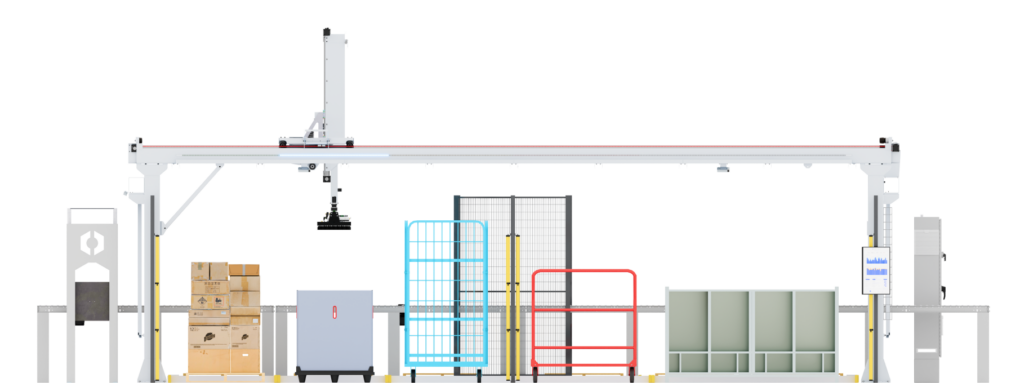
CARGO generalizes well to new item distributions, achieving high performance with little-to-no adaptation. In simulated rollouts on package data from customer production, CARGO exceeds 75% density, over 15% higher than the best baseline analytic algorithm we benchmarked against. We also deployed CARGO onto AmbiStack, our robot for mixed on-the-fly box stacking onto pallets and into walled containers. In live production evaluation, CARGO has achieved over 72.5% density at more than 340 sorts per hour, with both numbers climbing as production data flows back into training. Although direct comparisons are sparse within the literature and can vary across actual warehouse conditions, these results suggest that CARGO can achieve similar density to humans at 1.5-2x throughput [15-20].
The following sections provide more detail on CARGO’s training and performance: how we structured stacking as a planning problem, more details on the simulator, how policies transfer across item distributions, and what production data tells us about where Sim2Real task planning goes next.
Experimental Setup
CARGO’s goal is to generalize across unseen box distributions while being able to quickly adapt to new box sequences and distributions.
To achieve this, we train a base model on a large, diverse set of boxes and box sequences. First, we show how scaling pre-training for this base model can lead to strong out-of-the-box performance across box distributions and sequences unseen in training. Second, we show that in cases where test box distributions differ significantly from the training box distribution, post-training the base model can quickly recover the performance of training from scratch on the new box distribution directly.
Scaling
A key challenge in scaling training for CARGO has been to balance realistic box constraints such as stability and placement feasibility with simulation time. We want to allow the policy to quickly transition from placement to placement to explore a wide variety of potential box distributions, sequences, and intermediate packing states. At the same time, we want to limit the policy to choosing action sequences that can actually be executed on the physical hardware. Within this vein, we have developed a simulator that can validate a set of potential box placements respecting hardware feasibility and stability constraints and return a realistic container state within microseconds.
This breakthrough has unlocked consistent performance gains in CARGO’s ability to densely load containers, as shown in Figure 1. Scaling our simulation data from nearly 4 million box placements during training to almost 40 million increases density an average of 7% across two scenarios. In the figure, scenario 1 and scenario 2 represent two different packing container sizes with similar box distributions, showing that scaling holds across varied application specifics in training. Additionally, these results suggest that training on even more simulated placements and containers could continue to improve density. The experiments in this report were limited only by computation time/budget, and we aim to further scale experiments in the future.
Simulated Packing Performance and Generalization Capability
To quantify how much headroom remains, we benchmarked CARGO against an offline “oracle” solver that can optimize the entire item sequence to maximize density. It runs an anytime multi-start search and evaluates thousands of candidate item orderings in parallel, greedily evaluating each ordering using a heuristic, then improves the best solutions via local search over both ordering and box orientation. Given sufficient compute time, this method converges toward an upper bound that on-the-fly stacking policies cannot exceed, since it has perfect sequencing.
As a baseline, we also benchmarked against an Empty Maximal Space (EMS) heuristic online solver. The EMS heuristic is online, like CARGO, and iteratively tries to place boxes into best-fit empty rectangular volumes remaining within the container [21-22].
On the training distribution, CARGO achieves 89% of the oracle’s density (73.6% vs 82.5%). This gap reflects the inherent cost of making decisions without knowing future arrivals. CARGO maintains similar performance on Unseen Distribution A since it has near identical box shape statistics to the training distribution. As distributions diverge further from training (shown in the figure below), the gap widens. Unseen Distribution E, which consists of only two box SKUs and the sequences are arranged to ensure that 100% utilization is possible, exposes the largest gap between CARGO and the oracle, which always perfectly fills the container.
CARGO outperforms the EMS baseline across all of the distributions by 10-15% density, except for Unseen Distribution E, which is well-suited for a heuristic policy. This result suggests that CARGO is able to effectively plan several steps in the future to outperform a one-step policy and may encode some box distribution knowledge to predict future boxes that are likely to appear and be placed.
The variance across the six distributions from all policies suggests that an effective strategy for online bin packing depends to some extent on both the box distribution (both sizes and frequencies) and the container size, among other factors. CARGO shows strong generalization performance across multiple unseen distributions of boxes and can reliably pack unseen box sequences to 67% to 72% density without any additional training. However, when the distribution of box aspect and height ratios begins to diverge from the distribution that the model was trained on, performance can decrease.
In these cases, we can quickly recover performance of a model trained only on the new box distribution with just a few hours of training on the new distribution, as shown in Figure 4. This ability to adapt to new distributions highlights both the strength of the pre-trained model as well as its flexibility, giving customers confidence that they will see continued improvement within days of deploying.
Conclusion
CARGO marks a significant milestone: agentic Physical AI can achieve production-caliber performance on a real industrial task demanding both physical skill and long-horizon reasoning. Now, every container it builds adds critical data to our training corpus for training more powerful AI models. As the data flywheel spins, we aim to further scale training and reach superhuman levels of density. We also plan to adapt CARGO to general item sizes, shapes, and materials for other use cases.
In the longer term, we also aim to extend CARGO to a wider variety of tasks involving item arrangement, like order packing and kitting. We believe CARGO is a first step toward more general agentic Physical AI reasoning systems that can unlock a huge number of industrial tasks. We’re just getting started.
Want to scale physical AI in real world deployments? We’re hiring! See open roles here: https://www.ambirobotics.com/careers/
References
[2] Garey, M.R., and Johnson, D.S. (1979). Computers and Intractability: A Guide to the Theory of NP-Completeness. W.H. Freeman, New York.
[3] Martello, S., Pisinger, D., and Vigo, D. (2000). “The three-dimensional bin packing problem.” Operations Research, 48(2), 256–267.
[4] Crainic, Teodor Gabriel, Guido Perboli, and Roberto Tadei. “Extreme point-based heuristics for three-dimensional bin packing.” Informs Journal on computing 20, no. 3 (2008): 368-384.
[5] Ali, Sara, António Galrão Ramos, Maria Antónia Carravilla, and José Fernando Oliveira. “On-line three-dimensional packing problems: A review of off-line and on-line solution approaches.” Computers & Industrial Engineering 168 (2022): 108122.
[6] Pisinger, David. “Heuristics for the container loading problem.” European journal of operational research 141, no. 2 (2002): 382-392.
[7] Zhao, Hang, Qijin She, Chenyang Zhu, Yin Yang, and Kai Xu. “Online 3D bin packing with constrained deep reinforcement learning.” In Proceedings of the AAAI Conference on Artificial Intelligence, vol. 35, no. 1, pp. 741-749. 2021.
[8] Zhao, Hang, Yang Yu, and Kai Xu. “Learning efficient online 3D bin packing on packing configuration trees.” In International conference on learning representations. 2021.
[9] Zhao, Hang, Chenyang Zhu, Xin Xu, Hui Huang, and Kai Xu. “Learning practically feasible policies for online 3D bin packing.” Science China Information Sciences 65, no. 1 (2022): 112105.
[10] Hu, Haoyuan, Xiaodong Zhang, Xiaowei Yan, Longfei Wang, and Yinghui Xu. “Solving a new 3d bin packing problem with deep reinforcement learning method.” arXiv preprint arXiv:1708.05930 (2017).
[11] Xiong, Heng, Changrong Guo, Jian Peng, Kai Ding, Wenjie Chen, Xuchong Qiu, Long Bai, and Jianfeng Xu. “GOPT: Generalizable online 3D bin packing via transformer-based deep reinforcement learning.” IEEE Robotics and Automation Letters 9, no. 11 (2024): 10335-10342.
[12] Puche, Aaron Valero, and Sukhan Lee. “Online 3D bin packing reinforcement learning solution with buffer.” In 2022 ieee/rsj international conference on intelligent robots and systems (iros), pp. 8902-8909. IEEE, 2022.
[13] Bengio, Yoshua, Andrea Lodi, and Antoine Prouvost. “Machine learning for combinatorial optimization: a methodological tour d’horizon.” European Journal of Operational Research 290, no. 2 (2021): 405-421.
[14] Ray: a distributed computing framework. https://github.com/ray-project/ray
[15] Garg, Arun. “Ergonomic, biomechanical and physiological stresses from manual materials handling in grocery distribution centers.” In Proceedings of the Human Factors and Ergonomics Society Annual Meeting, vol. 44, no. 28, pp. 431-432. Sage CA: Los Angeles, CA: SAGE Publications, 2000.
[16] Garg, Arun. “Biomechanical and ergonomic stresses in warehouse operations.” IIE transactions 18, no. 3 (1986): 246-250.
[17] Wells, L. J., Gallagher, S., & Fathallah, F. A. (2024). Identification of ergonomics practices utilized in US grocery distribution centers: A survey of thirty facilities. Applied Ergonomics, 121, 104374.
[18] Elhedhli, Samir, Fatma Gzara, and Burak Yildiz. “Three-dimensional bin packing and mixed-case palletization.” INFORMS Journal on Optimization 1, no. 4 (2019): 323-352.
[19] CalcBee. “Cubic Capacity Calculator.” Accessed August 20, 2026. https://calcbee.com/calculators/logistics/freight/cubic-capacity-calculator/.
[20] Verstichel, Jannes, Wim Vancroonenburg, Wouter Souffriau, and Greet Vanden Berghe. “A Mixed Integer Programming Approach to the Aircraft Weight and Balance Problem.” Procedia — Social and Behavioral Sciences 20 (2011): 1051–59. https://doi.org/10.1016/j.sbspro.2011.08.114.
[21] Parreño, F., Alvarez-Valdes, R., Tamarit, J.M., and Oliveira, J.F. (2008). “A maximal-space algorithm for the container loading problem.” INFORMS Journal on Computing, 20(3), 412–422.
[22] Ha, C.T., Nguyen, T.T., Bui, L.T., and Wang, R. (2017). “An online packing heuristic for the three-dimensional container loading problem in dynamic environments and the Physical Internet” (EvoApplications).
Related Articles
-
 Blog | 09.17.2026Agentic Robotics Solves an Industrial Production ProblemNew Agentic Robotics harness within AmbiOS is now deployed across 30% of Ambi Robotics’ U.S. fleet, including systems operating for a Fortune 50 package shipping company.
 -
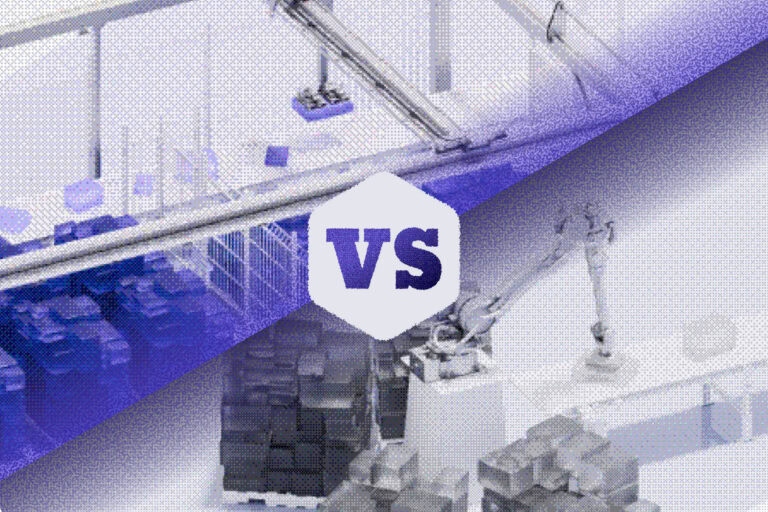 Blog | 07.22.2026Physical AI: Why Form Factor MattersThe shape of a robot matters more than you think. For operations leaders evaluating robotic palletizing systems, learn how workspace geometry, and the shape of a robot's reach, affects pallet density, uptime, and throughput per square foot.
 -
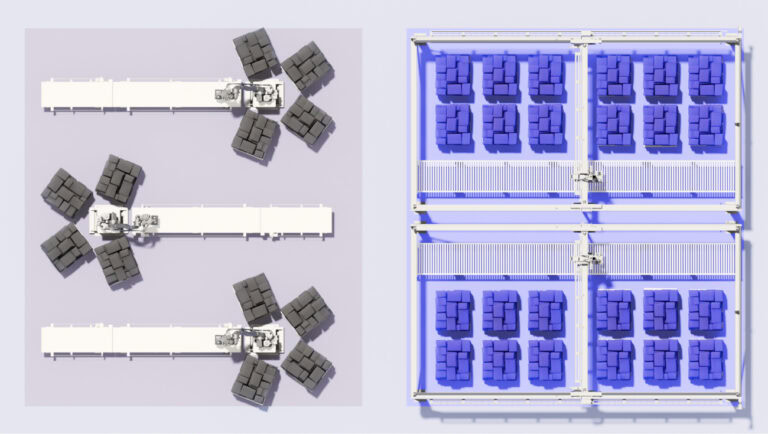 Blog | 07.15.2026Gantry vs. 6-Axis Robots for Palletizing: How Workspace Geometry Affects Throughput, Uptime, and Floor SpaceThe shape of a robot matters more than you think. For operations leaders evaluating robotic palletizing systems, learn how workspace geometry, and the shape of a robot's reach, affects pallet density, uptime, and throughput per square foot.