

Blog
Physical AI: Why Form Factor Matters
Tomorrow’s warehouse operation rarely looks like today’s.
New SKUs are introduced. Shipping destinations expand. Container types change. Conveyor layouts evolve. Customer demand shifts.
The work changes. Automation should be able to change with it.
For more than a decade, warehouse robots have become smarter. Advances in computer vision, machine learning, and AI have improved how robots perceive, identify, and manipulate objects. But intelligence is only one part of the system. The other is geometry.
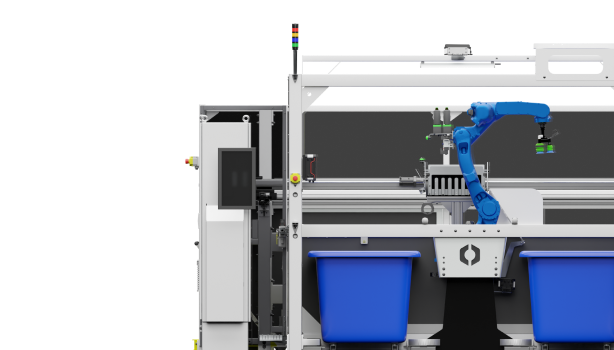
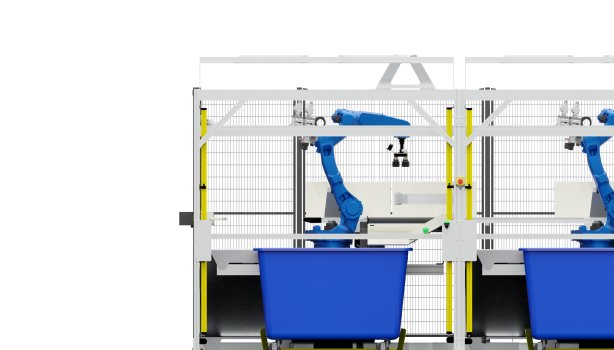
A six-axis robot arm is bolted to the floor, and its reach is constrained by its geometry. Faster processors and better AI models can improve reasoning and pick accuracy, but they cannot change how far the robot can physically reach.
In other words, the brain is constrained by the body.
That physical constraint can quickly become an operational constraint. In facilities serving dozens of outbound destinations or handling a mix of container types and conveyance systems, a fixed work envelope often means adding more robot cells, installing additional arms, or introducing manual handoffs downstream. Each solution increases floor space, complexity, and operating cost.
How This Stacks Up
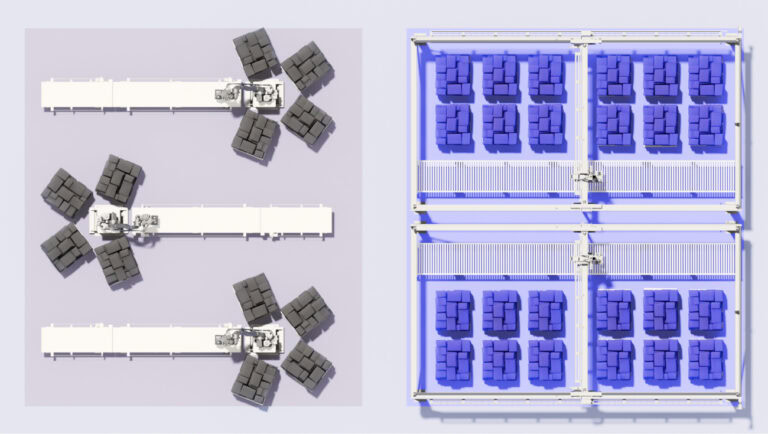
- A stationary six-axis robot arm typically reaches about four pallets at once. Expanding beyond that generally requires additional robot cells or additional arms.
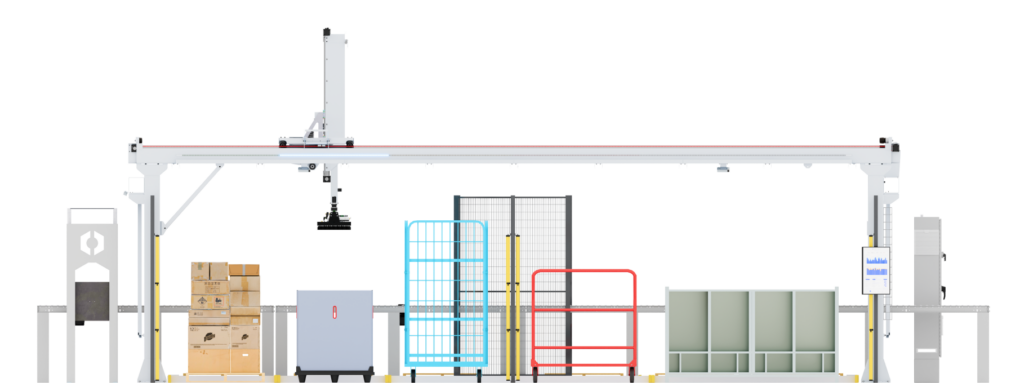
- A gantry system moves along overhead rails rather than pivoting from a fixed base, allowing a single system to reach many more pallet positions.
- Because the robot operates above the workspace, a gantry can accommodate different container types and conveyance configurations underneath it without requiring the automation cell itself to be redesigned.
Reach More
At Ambi Robotics, we believe automation should adapt to the operation, not the other way around.
Reach is one of the clearest examples.
A six-axis robot arm is limited by a fixed work envelope. A gantry system moves along overhead rails, allowing a single system to serve a much larger workspace. As the number of outbound destinations grows, that difference affects how many robot cells a facility requires, how much floor space they occupy, and how many times freight must be handled before it leaves the building.
Configurable, by Design
The same principle applies to configurability.
In a recent video, Ambi Robotics co-founder and CTO Jeff Mahler describes a gantry’s open, overhead architecture as “a bit like a Swiss Army knife” for stacking and packing. Because the robot operates above the workspace, facilities can arrange different container types and conveyance systems beneath it without fundamentally changing the automation itself.
A six-axis robot arm is optimized differently. Once installed, it is designed around a specific workspace and workflow. Accommodating new container types or changing conveyor layouts often requires meaningful engineering work.
The right choice depends on the operating environment.
A six-axis robot arm remains an excellent choice for highly standardized, repetitive applications. A gantry system becomes increasingly valuable where destinations multiply, container types vary, or operations need the flexibility to evolve over time.
Thinking Beyond Day One
Software will continue to improve. Robots are becoming faster, more accurate, and more capable. But software alone cannot overcome the physical constraints of the hardware it runs on.
The hardware you choose today will determine how much of tomorrow’s AI your operation can benefit from. Hardware remains in place for years. The software running on it continues to evolve.
Ambi Robotics explores these engineering tradeoffs in greater detail, including quantitative comparisons of workspace geometry, throughput, uptime, pallet density, and scalability, in its latest white paper comparing gantry systems and six-axis robot arms for warehouse palletizing.
Download the technical white paper: How Form Factor Determines Robotic Palletizing Performance
Related Articles
-
 Blog | 09.17.2026Agentic Robotics Solves an Industrial Production ProblemNew Agentic Robotics harness within AmbiOS is now deployed across 30% of Ambi Robotics’ U.S. fleet, including systems operating for a Fortune 50 package shipping company.
 -
 Blog | 08.26.2026CARGO: Physical AI for Industrial Package StackingIntroducing CARGO (Contact-Aware Reinforcement-learned Generalized Object-stacking): Sim2Real reinforcement learning for package stacking
 -
 Blog | 07.15.2026Gantry vs. 6-Axis Robots for Palletizing: How Workspace Geometry Affects Throughput, Uptime, and Floor SpaceThe shape of a robot matters more than you think. For operations leaders evaluating robotic palletizing systems, learn how workspace geometry, and the shape of a robot's reach, affects pallet density, uptime, and throughput per square foot.