


Blog
Gantry vs. 6-Axis Robots for Palletizing: How Workspace Geometry Affects Throughput, Uptime, and Floor Space
Why the Shape of a Robot Matters More Than You Think.
When evaluating robotic palletizing systems, speed often receives the most attention. Faster cycle times, quicker grippers, and shorter motion paths are all important. But in high-throughput warehouse operations, another engineering factor can have an even greater impact on overall performance: workspace geometry.
The primary difference between a gantry robot and a 6-axis robot is how each system moves through space. A 6-axis robot operates within a spherical reach envelope around a fixed base, while a gantry robot moves across a rectilinear Cartesian workspace. That difference influences how many pallet positions a robot can serve, how efficiently floor space is used, how safety systems affect uptime, and how well the system scales as throughput increases.
For many palletizing applications, especially those involving mixed SKUs, multiple destinations, and continuous production, workspace geometry can be just as important as robot speed.
Gantry Robot vs. 6-Axis Robot Comparison
| Feature | 6-Axis Robot | Gantry Robot (AmbiStack) |
| Workspace Geometry | Spherical reach envelope | Rectilinear Cartesian workspace |
| Pallet Positions | Typically 2–4 | 12+ |
| Productive Floor Space | Estimated 40–55% | Estimated ~95% |
| Safety Architecture | Single guarded cell (typical) | Zoned safety architecture |
| Effective Uptime | Estimated ~84% | Estimated ~99% |
| Candidate Infeed Positions | Typically 3–5 | 15+ |
| Practical Stack Height | Approximately 6.5 ft | Standard 8 ft |
What Is Workspace Geometry?
Workspace geometry describes the three-dimensional volume a robot can reach while performing work. In palletizing applications, workspace geometry determines how many pallet positions a robot can access, how efficiently floor space is utilized, and whether capacity can scale without adding additional robot cells.
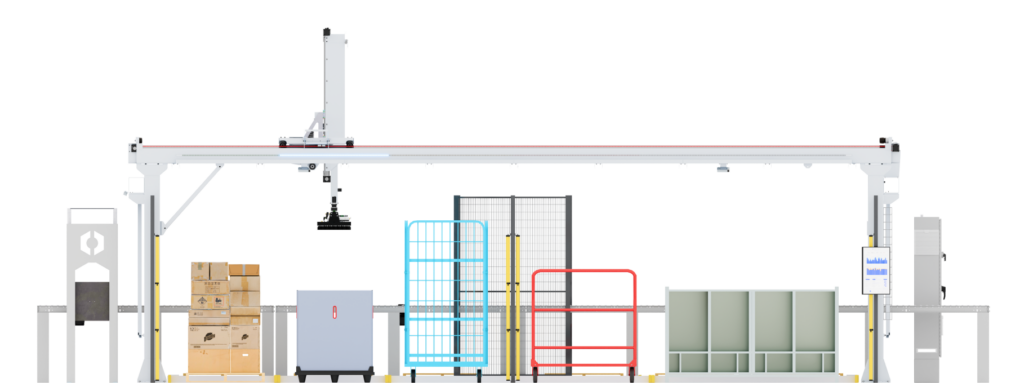
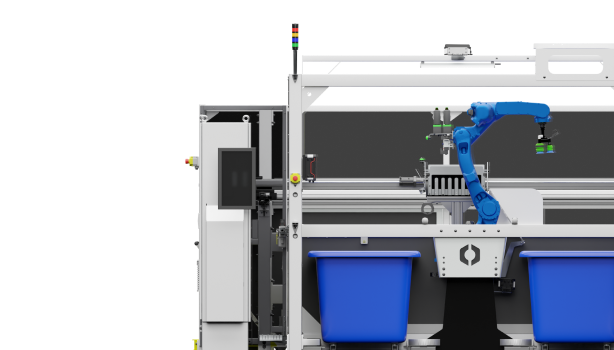
A 6-axis robot reaches outward from a fixed base, creating a spherical work envelope. A gantry robot travels along linear X, Y, and Z axes, creating a rectangular workspace that closely matches the layout of warehouse conveyors and pallet positions.
While both architectures have strengths, they optimize for different operating environments.
How Does Workspace Geometry Affect Palletizing Performance?
Within a single palletizing cell, a 6-axis robot’s workspace is typically sufficient. As operations expand to support twelve or more pallet positions, continuous multi-lane throughput, or mixed-SKU pallet building, the geometry itself becomes a limiting factor.
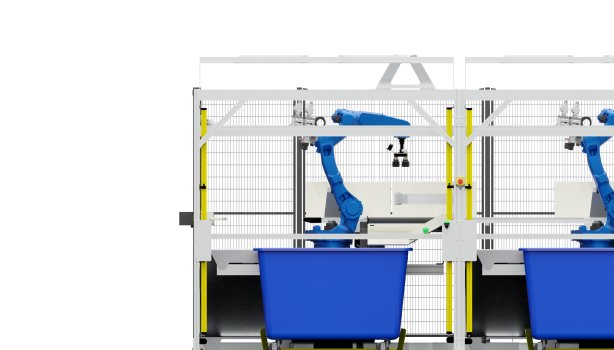
Because the robot rotates around a fixed base, portions of the workspace remain inaccessible while other areas require longer reach distances. Additional pallet positions often require additional robot cells or turntables to maintain throughput.
A gantry architecture scales differently. Coverage expands linearly with the length of the overhead rail system, allowing one robot to service a much larger rectangular work area without duplicating the entire robot cell.
How Many Pallet Positions Can a Gantry Robot Service?
Within a comparable footprint, a typical 6-axis palletizing cell services approximately two to four pallet positions.
A gantry-based system such as AmbiStack can service twelve or more pallet positions from a single robot head arranged in rows or grids that align with standard warehouse layouts.
For facilities managing multiple outbound destinations simultaneously, this can represent a three- to six-fold increase in serviceable pallet positions without proportionally increasing floor space.
Why Does Workspace Geometry Affect Floor Space?
Warehouse facilities are designed around straight aisles, conveyor lines, storage racks, and rectangular building footprints.
A spherical robot workspace naturally leaves unusable interior areas and irregular boundaries that can reduce overall floor utilization.
A Cartesian gantry follows the same geometry as the surrounding warehouse, allowing pallet positions to be arranged more densely within the installed footprint.
Engineering estimates place productive floor-space utilization at approximately 40–55% for a typical 6-axis palletizing cell compared with approximately 95% for a gantry architecture.
How Does Safety Architecture Affect Uptime?
Both gantry systems and 6-axis robots are designed to comply with applicable industrial safety standards.
The operational difference lies in how safety zones are implemented.
Many conventional palletizing cells operate as a single guarded zone. When personnel enter to retrieve a completed pallet, the entire cell pauses until access is complete and production resumes.
A zoned safety architecture allows retrieval activity within one zone while adjacent work zones continue operating.
At approximately six pallet retrievals per hour, engineering estimates suggest a traditional single-zone cell may lose roughly nine minutes of productive time per hour to safety interruptions. Under a zoned architecture, equivalent retrievals add approximately 36 seconds because only the active retrieval zone pauses.
The result is an estimated effective uptime of approximately 84% versus approximately 99%, depending on facility configuration and operating conditions.
Why Does Infeed Access Matter for Mixed-SKU Palletizing?
Building dense mixed-SKU pallets depends on having multiple package options available at every stacking decision.
A 6-axis robot is typically limited to packages located within its fixed reach envelope, often three to five candidate positions at any given time.
A gantry robot can access the full length of the infeed conveyor, giving palletizing software visibility into fifteen or more candidate positions without requiring additional staging buffers or pre-sort operations.
A larger candidate pool generally enables denser pallet construction, reducing outbound pallets and improving trailer utilization.
Why Does Robot Geometry Affect Stacking Accuracy?
As pallet height increases, placement precision becomes increasingly important.
A 6-axis robot often places upper pallet layers while operating near maximum reach extension, where payload and distance create larger bending moments that can affect positioning accuracy.
A gantry system maintains structural support across its overhead frame throughout the stacking cycle. Because vertical movement is guided rather than cantilevered, placement accuracy remains more consistent from the first layer through the top of the pallet.
Comparable deployments typically support practical stack heights of approximately 6.5 feet for 6-axis palletizing systems versus a standard 8-foot stack height for AmbiStack.
When Is a 6-Axis Robot the Better Choice?
6-axis robots remain an excellent solution for many automation applications.
Tasks involving flexible manipulation, compact work cells, lower throughput requirements, or complex end-of-arm orientations are often well suited to articulated robot architectures.
Workspace geometry becomes a more significant engineering consideration when facilities require high-density, multi-lane palletizing, mixed-SKU stacking, broad infeed access, and continuous production across many pallet destinations.
Engineering Summary
Compared with traditional 6-axis palletizing cells, gantry-based palletizing systems offer four primary engineering advantages in high-density warehouse environments:
- Larger usable workspace
- Higher pallet-position density
- Reduced downtime through zoned safety architecture
- More consistent placement accuracy across tall pallet stacks
These differences become increasingly significant as warehouse throughput, pallet density, and facility utilization requirements increase.
Methodology
Performance estimates presented in this article are based on engineering analysis of commercially available 6-axis palletizing systems and AmbiStack’s commercial production system architecture. Actual performance depends on payload characteristics, conveyor configuration, safety implementation, software optimization, and facility layout.
For the complete engineering methodology, workspace geometry calculations, safety architecture diagrams, and side-by-side performance analysis, download the technical white paper.
Download the technical white paper: How Form Factor Determines Robotic Palletizing Performance
Related Articles
-
 Blog | 09.17.2026Agentic Robotics Solves an Industrial Production ProblemNew Agentic Robotics harness within AmbiOS is now deployed across 30% of Ambi Robotics’ U.S. fleet, including systems operating for a Fortune 50 package shipping company.
 -
 Blog | 08.26.2026CARGO: Physical AI for Industrial Package StackingIntroducing CARGO (Contact-Aware Reinforcement-learned Generalized Object-stacking): Sim2Real reinforcement learning for package stacking
 -
 Blog | 07.22.2026Physical AI: Why Form Factor MattersThe shape of a robot matters more than you think. For operations leaders evaluating robotic palletizing systems, learn how workspace geometry, and the shape of a robot's reach, affects pallet density, uptime, and throughput per square foot.